
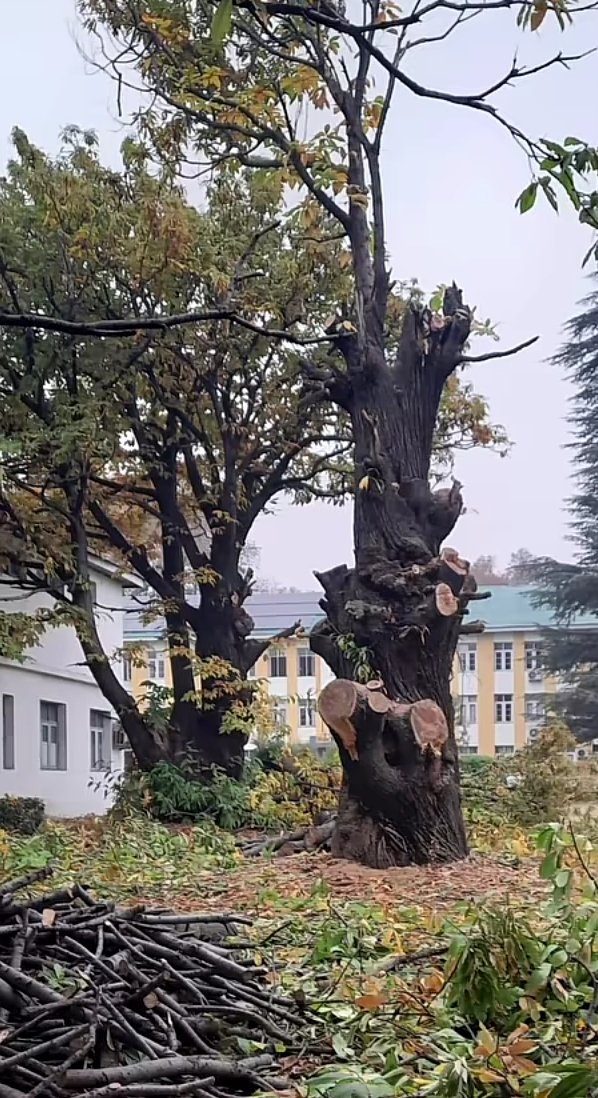
Raising the issue, noted environmental and social activist Dr Raja Muzaffar Bhat, Chairman of the Jammu and Kashmir Climate Action Group, expressed serious concern over the damage caused to the heritage chestnut trees located near the university’s History Department.
You don’t prune a heritage tree down to a stump. This is plain ecological murder. I have no words to express my anger-Dr. Raja Muzaffarpur Bhat
Highlighting the historical significance of these trees, Dr Bhat said that, according to his understanding, the chestnut trees were planted in 1924 by the then Maharaja of Jammu and Kashmir, Maharaja Hari Singh.
Dr Bhat maintained that such old trees cannot be viewed merely as ordinary vegetation that can be subjected to indiscriminate cutting or excessive pruning. They represent a valuable ecological and historical inheritance that deserves careful protection.
However, the university rebutting claims of ruthless cutting has maintained that the exercise was undertaken as pruning because certain branches were posing a potential threat to the adjoining building in the campus. Further, the varsity claimed plantation of over 10,000 Deodar trees and hundreds of indigenous species over the past decade as part of its endeavours to strengthen environment.
 Reacting to KU’s clarification, Dr. Bhat on X said said “Calling this ruthless Axing “PRUNING” is an insult to basic intelligence. Two Sweet Chestnut trees almost 100 years old planted on the orders of Maharaja Hari Singh way back in late 1920s have been ruthlessly axed on the University of Kashmir campus ? This is the same campus where lectures are given on Climate Change, Tree Conservation etc- This is how you practice all these things”.
The controversy has attracted attention beyond the environmental community. Vikramaditya Singh, grandson of Maharaja Hari Singh, expressed his displeasure over the incident, stating that those responsible should be held accountable.
JK Global News Take: The episode raises a larger question about how educational institutions and public authorities balance infrastructure safety with the preservation of natural and historical assets. While ensuring the safety in campus is undoubtedly important, the protection of century-old trees must also remain a priority. More importantly, the real measure of a university’s commitment to sustainability is not only the number of saplings it plants, but also how responsibly it protects the trees that generations before us have nurtured.