
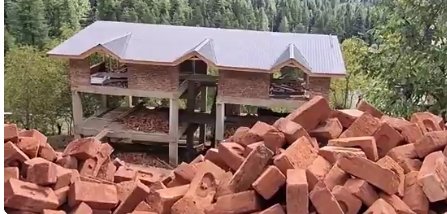
High Court restrictions, 578 reported unauthorised constructions and recurring demolition drives expose serious enforcement gaps; allegations of influential-builder nexus raise questions over administrative accountability
SRINAGAR: From Pahalgam’s green slopes to Sonamarg’s fragile mountain landscape, the mushrooming of hotels, resorts and other commercial structures is raising serious concerns over the protection of Kashmir’s ecological assets.
Allegations of large-scale construction violations, administrative inaction and preferential treatment for influential business interests have brought the functioning of regulatory authorities under scrutiny.
Recent India Today’s ground investigation highlighting Pahalgam’s transformation into a concrete jungle, has brought the issue into sharp public focus. The report has revived concerns over rampant constructions which have gained an alarming proportion in last two years after the formation of Omar’s led popular goverment.
The citizens and environment activists in Kashmir has raised concern over the oversight of watchdog against mushrooming constructions in length and breadth of Kashmir especially in green and ecologically sensitive areas, despite judicial restrictions and planning regulations.
Setting the record straight, the Pahalgam’s construction controversy has a long judicial history. In Pahalgam Peoples Welfare Organization versus State of J&K, PIL No. 484/2010, the High Court dealt with environmental concerns and directions concerning the Revised Master Plan 2032.
The court ordered demarcation of forest, wildlife and buffer zones, along with identification of areas where construction was prohibited. The restrictions are zone-specific and do not constitute a blanket construction ban across the entire development area.
The High Court’s March 27, 2023 order in Sonamarg PIL No. 404/2011 was more categorical. It prohibited fresh construction throughout the Sonamarg Development Area, irrespective of whether permission had been granted by a competent authority. Only court-approved repairs and renovations, subject to prescribed permissions, were allowed.
The Chief Executive Officer of the Sonamarg Development Authority was made personally accountable for compliance, with contempt proceedings threatened in case of violations.
Interestingly, despite these judicial safeguards, construction-related violations continue to surface. In September 2026, the Forest Department intervened over construction activity near Mamal in Pahalgam’s forest zone, directing that work be stopped and seeking a report on how it had commenced.
Even, the official records of 578 unauthorised constructions put spotlight on enforcement. The scale of the challenge became evident when Chief Minister Omar Abdullah, while replying to a question by PDP legislator Waheed-ur-Rehman Parra in the Legislative Assembly in April 2026, disclosed that 578 unauthorised constructions had been identified across tourist destinations in Jammu and Kashmir.
Disclosure of Gigantic figure of unlawful construction in the Assembly assume significance when the portfolio of tourism centric Authorities as well Housing & Urban Development is headed by none other than CM Omar Abdullah.
Following is the data furnished by Government
-
Pahalgam: 28 unauthorised constructions identified; 13 sealed.
-
Gulmarg: 21 identified; 20 sealed and one demolished.
-
Sonamarg: Five cases reported.
-
Doodhpathri: 147 unauthorised constructions identified, with notices and FIRs reported.
-
Patnitop: 15 structures demolished.
-
Verinag: Four violations penalised.
-
Bhaderwah: 358 notices issued in connection with construction violations.
The figures have raised questions about the effectiveness of monitoring by specialised development authorities and whether enforcement agencies are intervening at the initial stage or only after substantial construction has taken place.
As a matter of fact, this modus operandi adopted in almost every illegal constructions throughout the length and breadth of the J&K UT, reflecting a well entrenched nexus among watchdog, violators and construction contractors as well as middlemen.
This unstoppable problem is not confined to only tourist destinations in Kashmir. Recently, the civil society in Srinagar has criticised the Srinagar Municipal Corporation for their alleged complicit silence over alarming illegal constructions especially commercial in nature which have made their life miserable in residential areas and colonies.
Facing growing criticism in public domain, the SMC reportedly carried out 50 demolition drives and sealing three structures during September 2026. It subsequently sealed five more unauthorised structures across different parts of the city.
Meanwhile, residents and environmental activists have questioned the effectiveness of demolition campaigns, describing some operations as selective and insufficient to address the underlying problem. Their contention is that removing a few structures after substantial commercial investment cannot compensate for alleged years of administrative inaction.
They have also questioned why unauthorised constructions are allegedly allowed to reach advanced stages before enforcement agencies intervene, and whether officials responsible for granting permissions, conducting inspections and preventing violations have been held accountable.
Though recently, the Anti Corruption Bureau has registered FIR against some officials of SMC in connection with their failure to act againt construction of commercial structure sans building permission.
However, against the backdrop of alarming illegal constructions which are going at rocket speed in entire J&K especially in and around upcoming commercial hub, the citizens view ACB action against officers and Officials of enforcement wing of SMC as token exercise. They demanded dismantling multi-crore gratification racket operating the business of patronized illegal constructions.
On the other hand, the environmental activists maintain that with hundreds of violations officially reported and judicial restrictions already in place in ecologically sensitive areas, the critical question confronting the authorities is not merely how many structures have been sealed or demolished, but how they were allowed to come up in the first place and whether those responsible for regulatory failures have been identified and punished.