
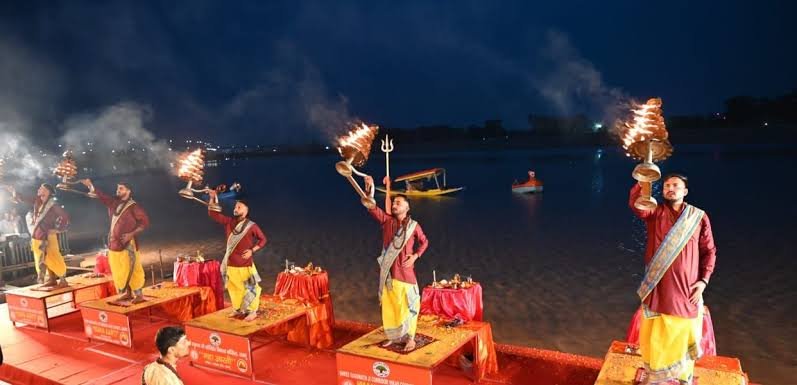
For decades, the sacred River Tawi has remained the spiritual lifeline and cultural identity of Jammu. Revered as the Surya Putri, the river occupies a special place in the hearts of the Jammuites, yet its immense tourism and cultural potential remained largely untapped. The introduction of the Tawi Aarti has changed that narrative by transforming the riverfront into a vibrant centre of faith, culture and public engagement.
Conceived and promoted by the Jammu Municipal Corporation (JMC) and Jammu Smart City Limited (JSCL) under the guidance of Commissioner Dr. Devansh Yadav, the Tawi Aarti stands out as one of the most innovative urban tourism initiatives undertaken in Jammu in recent years. While inspired by the celebrated riverfront Aartis of Varanasi and Haridwar, the initiative has successfully carved out its own identity by celebrating Jammu’s rich Dogra heritage and spiritual traditions.
More than a religious ceremony, the Tawi Aarti has evolved into a cultural spectacle that attracts devotees, tourists, photographers, families and evening visitors alike. The rhythmic chanting of hymns, the glow of hundreds of lamps reflected on the flowing waters and the serene ambience have breathed new life into the riverfront, creating an experience that was unimaginable just a few years ago.
The recent introduction of Shikara rides and boating is a clear indication that the Tawi Riverfront is poised to emerge as one of North India’s most attractive tourist destinations in the years to come. More importantly, this visionary initiative demonstrates that with foresight, determination and sustained planning, Jammu too can evolve into a vibrant tourist destination on par with Kashmir, leveraging its own unique cultural, spiritual and natural heritage.
The initiative also exemplifies how modern urban planning can harmoniously blend with heritage conservation. It complements the larger vision of riverfront rejuvenation by encouraging public participation, beautifying the riverbank and promoting responsible use of public spaces. Such initiatives not only strengthen civic pride but also reinforce Jammu’s identity as the “City of Temples.”
From a tourism perspective, the Tawi Aarti has the potential to emerge as a signature attraction of Jammu, encouraging pilgrims visiting Shri Mata Vaishno Devi Shrine as well as Shri Amarnath Ji to extend their stay and explore the city’s cultural offerings. Along with events like the Tawi Festival, heritage walks, boating activities and improved riverfront infrastructure, it can significantly contribute to the local economy by benefiting hotels, restaurants, transport operators, artisans and small vendors.
However, if Jammu truly intends to unlock the full tourism potential of the Tawi riverfront, the next phase of development must focus on creating world-class visitor infrastructure. Tastefully designed open-air cafés, Dogra cuisine restaurants, food courts, tea lounges and river-view eateries along the embankment can transform the area into a lively leisure destination. Landscaped promenades, viewing decks, cultural plazas, souvenir kiosks and boutique hotels overlooking the river would encourage visitors to spend more time in Jammu rather than treating it merely as a transit city for pilgrims. Such infrastructure, if developed in an environmentally sustainable manner, would create employment, stimulate private investment and position the Tawi riverfront among North India’s finest urban waterfront destinations.
The success of the Tawi Aarti also demonstrates that urban development is not confined to constructing roads, bridges and buildings. Equally important is the creation of public spaces that celebrate a city’s heritage, foster community participation and provide meaningful cultural experiences. Cities become memorable not merely through concrete infrastructure but through the traditions they preserve and the experiences they offer.
While sustained maintenance, cleanliness, effective crowd management and year-round cultural programming will determine its long-term success, the concept itself deserves appreciation. With consistent institutional support, wider public participation and continued infrastructure development, the Tawi Aarti can evolve into an iconic cultural tradition comparable to the renowned riverfront ceremonies of other historic cities.
The Tawi Aarti is, therefore, far more than an evening ritual. It represents a thoughtful blend of faith, culture, tourism and urban renewal. It reflects a progressive vision that recognises heritage as an engine of economic growth and tourism development. If nurtured with the same commitment in the years ahead, this innovative initiative by the Jammu Municipal Corporation and Jammu Smart City Limited under the leadership of Commissioner Dr. Devansh Yadav has the potential to redefine Jammu’s image as a vibrant tourist destination where tradition, spirituality and modern urban planning converge on the banks of the timeless River Tawi.